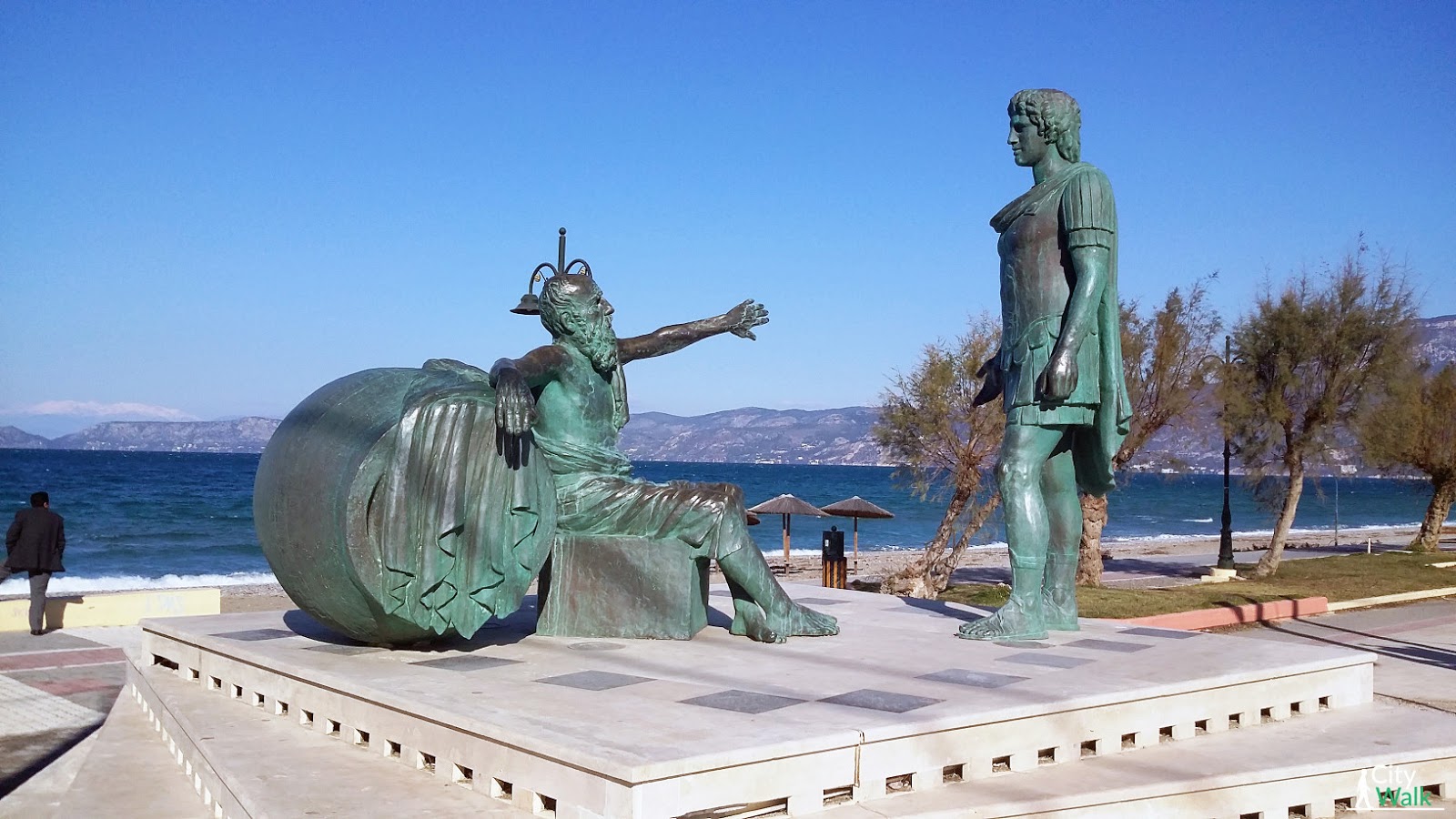
Showing posts with label Diogenes. Show all posts

Monday, 16 March 2020

ANARCHISM IS NOT SOCIALISM AND ITS NOT CIVILISATION

I have been reading the works of two differing anarchists, the American Lucy Parsons and the Italian Errico Malatesta. Both are regarded by modern students of anarchism as genuine anarchist voices from the past. But when I read them I have problems and they are problems I have with those who conceive of anarchism generally as a matter of human, political action generally. These problems are not concerned with their words condemning the actions of government and the human lack of need for such an entity. Both equally well expose government as the exploiter of the many for the benefit of the privileged few, and for the capitalist class in general, equally well. Both show how government and corruption by capital interests are unavoidable bedfellows just the same. On this, we have no disagreement. 


                                   Lucy Parsons and Errico Malatesta


It is, however, when we come to what replaces this in their various rhetorics that the differences emerge. Parsons, for example, talks about our need to be “civilised” as if “civilisation”, and the values of such a thing, were our friend. Malatesta, on the other hand, whilst keen to remove the yoke of government, is equally keen to replace it with another yoke called “solidarity” or, in other places, “voluntary solidarity” although, in that latter formulation, it is not clear that this is voluntary since, throughout his 1891 pamphlet “Anarchy”, he seems to argue for its necessity in replacing government in society rather than our ability to forego it. Indeed, Malatesta in that same document suggests that the “freedom” he and anarchists like him want is “not an absolute metaphysical, abstract freedom”, something which he imagines can be perverted into oppression, but the freedom “which is the conscious community of interests”. Malatesta imagines that if we had this then we would have the freedom which is each member of society chipping in and doing their bit quite willingly and cooperatively.


Yet my mind goes back to one of my imagined forebears in spiritual and philosophical anarchism - Diogenes the Cynic. Judged by the civilised and - let us speak plainly - socialist standards of Lucy Parsons and Errico Malatesta was Diogenes, who defaced coinage, took advantage of whatever natural food and shelter he could find and lived a mostly solitary life [albeit he mingled with others] an anarchist? By their standards, no. But this then becomes exactly the point at issue and that point is the values involved. There is a certain type of anarchist - Malatesta and Parsons may well be two examples of such - for whom anarchism is basically socialism and for such people these two are not so much constant bedfellows as they are regarded as the same thing. I am not one of these people and, for me, anarchism neither implies nor requires socialism - nor is socialism necessarily anarchism at all. There are obvious 20th century examples of why this is so. Russia and the Soviet Union, for example, might have been socialist but this was not anarchism. And, to be honest, I find it just as hard to imagine how state socialism, which is what any socialism founded on the basis of national borders would be, is any kind of anarchism at all. 


Yet this is not the root of the problem. For the root of the problem we need to go beyond the reordering of the deckchairs on the Titanic of society that those such as Parsons and Malatesta undertake. Such people survey society and see oppression, poverty, squalor, the domination, economic and political, of some by others, and they condemn it as unjust, unnecessary and unconscionable. I am with such people entirely when they do that and largely for the reasons that they give. A modern, capitalist state is an engine of exploitation that aims to profit a few at the expense of the many and no genuine anarchist could stomach its continuance for any longer than it takes to replace it. However, for all its many irredeemable faults, such a political organisation of society has obviously had certain consequences. It has created a certain kind of civilisation, the kind we see around us today. Indeed, such states have been precisely the process of ever deeper and more thoroughgoing “civilisationing” of human society. This has created not just certain material conditions as the contexts for increasing numbers of lives but a whole raft of expectations - civilised expectations - which certain self-proclaimed anarchists have then seemed to take up and take over as if these were to be incorporated in something properly called anarchism. Diogenes had expressed anarchism as a rejection of civilisation at the level of a 4th century BCE Greek city state. In recent centuries, we’ve had anarchists who wanted to anarchise 19th, 20th and 21st century civilisation rather than to replace or ignore it.


In order not to be misunderstood at this point I should like to make it plain that, contrary to notable anarchists of past and present, people like Parsons and Malatesta, I want to question if the anarchist progress we seek is simply a matter of the political reorganisation of society for the purpose of retaining the imagined benefits of civilisation but by means more politically palatable and justifiable. Should government be kicked out and “solidarity” [which is really Malatesta’s word for socialism] be put in its place, are we any better off? Are we more free? Is this anarchy? What, to question Lucy Parsons, has being “civilised” got to do with any of this when someone like Diogenes [and perhaps also the proto-Daoists] would have told us that being civilised was exactly the problem? Is there a place here for the naive idealisms of those who would tell us that, were human beings set free from the yoke of government, a sentimental feeling would descend upon them and then all human beings together would suddenly work as one for the good of all, old enmities forgotten and old values set aside? It is true to say that both Parsons and Malatesta point out that a good deal of education might need to take place before such things could be achieved - and surely both do realise that people are educated primarily by that which they become used to - but a fundamental question remains in place for both of them and all those like them who see anarchism as the work of political reorganisation of society: does your kind of freedom give me, and any others, the freedom to ignore the context you wish to impose upon things and to mind our own business? Those who care about political organisation will, it seems to me, insist on their preferred options for they are saying its something we must determine, create and keep in place. Such things are a form of civilisation.


So, as I read Parsons and Malatesta, I am not always so sure that their version of freedom leaves us what I would call anarchistically free. They both seem to want a de facto political organisation to be the case in the world. They both configure the world socially and want to determine the context for social interaction taking place to provide for the needs of human beings. In short, they both, and certainly not only they in the history of political anarchism, imagine civilisation continuing, if in ways more politically suitable to their tastes. They are, I think, thinking of people as classes and imagining the world based on what they regard as the right relationships between these classes. They have become obsessed with a certain kind of political theorising, one that focuses on a socialist/capitalist binary opposition. This is their first, and a fatal, mistake, one the Daoists of old did not imagine when they imagined the Daoist idyll, as they sometimes did. Their thinking has been shaped by the world of their experience and its values in a way they might not have realised so that what civilisation wants they want too - but just by better means, as they see it. 


Yet people are not classes. People are individuals. People may think for themselves, act for themselves and decide their own needs and priorities in life for themselves. Indeed, most of us would imagine some kind of coercion to be taking place where such things were inhibited. Civilisation has told people that certain standards and certain things are things that they should expect to have and be induced to want and, in some but not all cases, anarchists, perhaps persuaded by the need to have a convincing rhetoric for civilised people, seem to want them too. But I can’t go along with them. Civilisation, its values and its tendencies, are the problem and not the solution. An anarchised civilisation is a contradiction in terms. Its anarchy or civilisation, as the first anarchists suggested, and not anarchy and civilisation. You can’t have anarchy and an organised economy for anarchy says things will organise themselves without it being any kind of organisation at all. So you might have to choose between anarchy and Netflix rather than imagining you can have both. You might have to do without mobile communications devices if you want social justice and equality. You might have to source your own food and maintain your own shelter and do without wasting your time watching You Tube videos if you want an end to government.


I am, of course, suggesting that anarchism, anarchistically configured, does not concern itself with the world. That, in fact, is exactly what the anarchy of nature is [and so often the anarchy of those taking their cues from nature as the first anarchists did]. It is not concerned with how things turn out for everyone or the prosecution of an ideologically acceptable plan for the world. It has no plan: it just takes place for it is not civilised. It is at odds with that kind of anarchism which is a political motivation for the pursuance of social and organisational goals. Anarchy has no goals and anarchism is merely the practice of life where one is free - and not least free from civilisation and its centralising tendencies. In this, I have no doubt that human solidarity would be a good thing in many cases and I don’t think that, in every case, “civilised” values are uniformly bad. Yet neither do I think that these are things that should be mandated or should be goals. There shouldn’t be any goals: this is anarchy! If any given person is not free to not want what you want, to not act as someone else prescribes, than I see no anarchy here. I see the coerced compromises of civilisation [even a socialist civilisation!] which become the hegemonies of a privileged few or the forced customs of collectives - and I see both as equally undesirable. So anarchism for me is the dissolution of borders and the annihilation of countries and the concept of nationality. It is a revaluing of all values, as Nietzsche described it, because anarchism is, first and foremost, a matter of values and not of politics and political organisation. It is about each person at the personal level and not about how people are organised when thought of as groups or classes of person. Anarchy, first of all, is the situation we as living human beings are in, a state and condition of our existence, and not something we may or may not create. Anarchism that rushes straight to how society is politically ordered is more concerned with ideological organisation than anarchy’s disorder as order. It is anarchism that has forgotten that no leaders means no leadership except that which each being has as a part of its own constitution.


But now you’re scared because my anarchism seems a lot more anarchic than yours. Its dangerous and not safe. Its anarchy that you don’t control! [What else would anarchy be?!] You might actually have to take responsibility for the whole of your life under my description of such an anarchism. The safety net is hard to see here. But did Diogenes talk about a safety net? Did Zhuangzi imagine us worrying about medical care for society? Civilisation does that, promising you long life and peace so long as you participate in its game. Do you believe this lie it cannot demonstrate in practice? Anarchy and anarchism, on the other hand, now becomes the spiritual and philosophical thing I have been claiming all along it is exactly because of this: it is a matter of differing values. Its a matter of asking what your life is and how it comes to be and you can’t go any further with anarchy and anarchism until you have answered this question. Many, of course, well known anarchists included, never ask this question and assume that civilisation, and the values it promotes and supposes, is what life is all about: what it provides, an imagined anarchist society should also provide. Therefore, such people never question if civilisation has got life right or not and neither do they ask how civilising activities have shaped and affected the people it has maintained and supported. Yet its exactly that that the spiritual and philosophical anarchists do put in question. Is life about its length, as a civilised person might maintain, or its quality regardless of length, as a spiritual and philosophical anarchist might maintain, for example? Is it about “social wealth”, as the civilised Malatesta suggests, or individual freedom in a world that is a natural anarchy, as a spiritual and philosophical anarchist might suggest?


Be of no doubt that where you land in answering these questions will determine what values you have. For me, anarchism must be more thoroughgoing than wanting to supply the same kind of life to people, albeit one with more equal distribution of resources in a world more free of coercion, on better political terms. As I have already described it, this type of anarchism seems little more than reorganising deckchairs on the Titanic so that everybody gets a bit more of the sun on the way down. This, it seems to me, whilst not a bad outcome, is an inadequate one and one in which anarchism is reduced to a political theory and so restricted from being genuine anarchism. As my metaphor suggests, its an epic missing of the point. Such a genuine anarchism would be an anarchism of values and goals, a real freedom rather than a freedom to be told to live in another way that isn’t like the old way you were told to live in before. Enforced socialism is no more anarchism than statism, government or capitalism is. Genuine anarchism is self-knowledge, self-education and self-determination, albeit in a world where you are not the only thing that exists.


You might reply that socialist civilisation is better than capitalist civilisation though and I wouldn’t really disagree. But I’m an anarchist and not a socialist and anarchism is not socialism! I believe in freedom pushed to its farthest possibilities and that means freedom from societal values, from civilising, as much as it means freedom to share values with others. It means freedom from the centralising tendencies of the socialist human being as much as the capitalist one and we may note here that both might equally want “civilisation”, regardless of their other profound differences, for civilisation services both equally well. It means noting that civilisation itself is far from a benign outcome of human existence and activity, one that has, in myriad ways, produced multiple forms of harm. Even as I write this there is a global panic about Covid-19, a corona virus, the spread of which has been magnified and enabled many times over by the existence of civilisation even whilst that same civilisation argues over how, or even whether, to stop its spread. This has all been made incredibly more complicated by civilised people’s need to carry on with their civilised lives, the form of life many of them are now entrapped within in their metropolitan existence. Numerous civilised people have hoarded supplies leaving the most vulnerable with little or nothing. “Yay!” for civilised values and the world it has created by creating networks people could take advantage of in order to hoard. Such forced centralisation, a by-product of the civilisation project, has endangered us all. It is not clear that socialism would have saved us either although in more socially-minded countries they seem to have got it under control better than those not so socially-minded.


This is but one current example and I encourage everyone to think about civilisation and the pitfalls of its existence and the problems it creates. They are things at least some anarchist forebears thought were destructive of a proper humanity. I also encourage people to compare it to the anarchism of actionless action that I have spoken to in my series of books on the subject of anarchy. My argument here, as part of that wider argument, has been that anarchism is not socialism even though anarchists may choose to act socially or even out of social concern. It has also been that anarchy and civilisation are two very different and, in my view, incompatible things. If you look at the characteristics of anarchy as I have discussed it in four books it is not something deliberately organised with set aims and purposes or desired outcomes. Anarchy, and so any anarchism that models its manner of operation, has no desired outcomes but only the outcomes that can, at any given time and place, happen. 


Accepting this would, no doubt, require a change of mind in a great many who now consider themselves anarchists yet who would also not like to lose the relatively comfortable, civilised lifestyles that they have been in receipt of thanks to civilisation - if they can help it at all. Unfortunately, though, they must choose. This is because anarchism, whilst being about the exploited workers on poverty wages and the corporate conglomerates who wants to poison your land so that its executives can become billionaires, is also about whether having a mobile phone is compatible with social justice or if owning luxury possessions is compatible with the world taking place as it can without desire or intention. I think its not and so I see civilisation and anarchy as antagonistic as Diogenes did and as the first Daoists did, those who placed simplicity far above civilisation - thought of as values. They were those who thought the antidote to civilisation's ills was simplicity. So I see civilisation as the problem rather than, as sadly all too many do, as the standard. And so I see authentic anarchist living, the practice of an anarchist life, as not something that civilisation gets to define or standardise. “Peace comes from within. Do not seek it without,” The Buddha is reported to have said. Doing so, it seems to me, he suggested that organising the world, even in ways we might imagine better, is not our concern. And besides, it will organise itself anyway along much more properly uncivilised, anarchist lines. All by itself. That is what I think Cynics and Daoists alike once understood very well.


And its the only way it can.


This is an extract from the fourth and final book in my series on spiritual and philosophical anarchism called There is Nothing to Stick to. It will be titled The Spiritual Anarchist's Philosophical Handbook. The three volumes published so far can be read here

Tuesday, 15 October 2019

DIOGENES AND NOTHING TO STICK TO: THE DOG WHO DENIES CIVILISATION


The history of Diogenes of Sinope, peripatetic philosopher, rascal and hound, is now told in numerous tales which, we must state frankly, may or may not be true. Put bluntly, who knows? Who now, millennia later than a man claimed to have lived between roughly 412-323 BCE, can even hazard a guess? Yet we do know that he was remembered and that writers and biographers in the Hellenistic Roman world were interested in memorialising the man known as a dog and that he was someone famous in that world for the anecdotes told about him and the character revealed in them. This, in itself, is something noteworthy for it is not the fate of every, or even most, human beings to be remembered centuries, let alone millennia, after their death.


One person who took it upon himself to record a broad swathe of the history of Greek philosophers was Diogenes Laertius. He was likely active in the first half of the third century CE and so at least 500-550 years after Diogenes had lived. In his Lives and Opinions of Eminent Philosophers, which is now our major secondary source for Greek philosophy and philosophers, he recorded, in ways most experts think largely impartial and unexpanded, although certainly also largely uncritically, the details of the lives, opinions, sayings and deeds of Greek philosophers as much as he was aware of them. Often there would be differences of opinion - some said this happened, others said that, etc., - but Diogenes Laertius would then simply record the variants he was aware of and leave it to readers to decide what to do with the information. His book is not a philosophical book and neither does he himself set out to discover the truth of the matters he reports. Instead, he supplies a compendium of tales and leaves it largely at that. I have, so far, spoken about “his book”. But, in fact, Diogenes Laertius wrote 10 books in what was, in reality, a multi-volume work. Some philosophers, such as Plato or Epicurus, get a volume all to themselves [books 3 and 10 respectively] whereas others cover the notables from philosophical schools such as the Stoics or the Pythagoreans, etc. It is in book 6 that Diogenes Laertius turns his attention to The Cynics and the second philosopher he deals with under this rubric is Diogenes of Sinope. I want to survey this material now to present a picture of that philosopher whom, so it is said, even Alexander the Great wished to be if he could not be Alexander.


Diogenes was originally the son of a banker, Hicesias, on the southern coast of the Black Sea which is now northern Turkey but which was then colonised by Greeks. It is said that during his time in Sinope working with his father the currency that his father was in charge of, this being the coins that he was responsible for minting, became deliberately debased, making them worthless. For this his father, or Diogenes, or both of them, were imprisoned and banished respectively. Diogenes lost all his possessions and his citizenship as a result of this incident, for which he was exiled, and which has since been historically verified through archaeology in modern day Sinop which has revealed lots of coins which were deliberately debased in the mid 4th century BCE. This, as one powerful, and likely truthful, incident is extrapolated as an explanation of the later public character of Diogenes, a man who would debase and destroy the numismatic lifeblood of civilisation itself and attempt to make commerce impossible. Indeed, this very story of the currency being defaced was later metaphorically applied to Diogenes’ activity more generally and he was regarded as the debaser and defacer of civilisation itself.


After his exile from Sinope, and as a stateless individual, Diogenes next turned up in Athens where it is said he attached himself to the philosopher Antisthenes. Antisthenes had been a student of Socrates himself, a revered philosophical figure of the time and one in whose shadow many later philosophers would stand. Yet it seems that Antisthenes was not keen to accept Diogenes as his student and even took to beating him with a stick in order to dissuade him. Yet the tale told about this makes sure to tell us that Diogenes was steadfast and resolute in his desire to be taught by the words of such an eminent philosophical figure. This is presented as Diogenes being desirous of both virtue and wisdom when he says, “Strike, for you will not find any stick hard enough to drive me away as long as you continue to speak." 


At this point we learn of Diogenes’ “simple mode of life”, something explained as one consequence of his loss of possessions, citizenship and exile but also as a result of his observance, and learning from, nature. So we are told that Diogenes learns to wander about without worrying where he will sleep from a mouse and that he utilised his cloak, his only garment, as a bed. He carried a wallet, a bag over his shoulder, to carry scraps of food and used the natural environment as his dining room, his meeting room and his bedroom. Also related here is that, being unable to secure permanent accommodations, he made use of a discarded cask or barrel for such purposes and without any hint of shame or disgrace in his homeless state. Seeing a child drinking water out of its hands, Diogenes learns to do without a cup and, in similar wise, he learns to use a hunk of bread as a spoon, dispensing with the latter utensil as well. Here “simplicity” was an express aim of the virtue of Diogenes. Being constantly outside in such circumstances, it is related that Diogenes took to purposely innuring himself to environmental conditions, rolling in hot sands in summer and embracing snow covered statues in winter, the better to deal with extremes of temperature. He also wore no shoes. In matters of sustenance he was said to content himself with plain food and drinking only water. In matters of bodily functions, including masturbation, he carried them out in the open air and where he might be seen, such as in the marketplace, again without shame or disgrace as any other innocent creature might do. It seems Diogenes did not favour marriage as is expressed in the anecdote in which he replied to a questioner asking when a man should marry, "Young men ought not to marry yet, and old men never ought to marry at all." He did not practice a pride in appearance or the flattering of others by such means and is reported to have said to a youth smartening himself up very carefully, ''If you are doing that for men, you are miserable; and if for women, you are profligate." Diogenes in his habitual appearance and practices, then, disdained common yet artificial standards in favour of an uncivilised life.


What Diogenes is not presented as is a man shy of expressing opinions or as one who hides himself away from the business or discourse of others. As one old English translation of the account of Diogenes Laertius puts it, “He was very violent in expressing his haughty disdain of others.” Diogenes, in fact, is presented as someone very clever with words and a master of the put down. On numerous occasions he is depicted bandying words with others, from slavers to people who are hosting him to notables such as Plato, and on each occasion he showcases a caustic wit which is often deeply critical of some thought or idea or current practice whilst utilising clever wordplay at the same time. For example, he calls the “discussions” Plato has [which is to say his philosophy, in Greek his ‘diatribe’] “disguises” [in Greek ‘katatribe’] intending to suggest that what Plato and his hearers regard as the greatest of philosophies, philosophies which are revealing the order of things are, in fact, shrouds thrown over reality which turn it into something it is not. Diogenes is also notable for numerous broadly political observations which are critical of the “civilised” context of a Greek city such as Athens. He criticises the Dionysian festivals which were at the heart of Greek cultural life, the Olympic games which were of similar stature in Greek cultural life and denounces demagogues as “ministers of the multitude”. Sometimes he is dismissive of human beings in general as when he is reported to have thought of them as the most stupid beings of all or as in when, asked where in Greece he saw human beings, he answers “Nowhere”. In general terms it can be said that there are many examples of sayings where Diogenes bewails the fact that human beings do not attend to their virtue, which is a matter of asking what is really valuable for human beings in who they are and how they live, or to its pursuit and that he denigrates human beings generally for that fact.


We can see examples of this type of thinking in examples such as the following:


He used also to say, "That the musicians fitted the strings to the lyre properly, but left all the habits of their soul ill-­arranged." And, "That mathematicians kept their eyes fixed on the sun and moon, and overlooked what was under their feet." “That orators were anxious to speak justly, but not at all about acting so." Also, "That misers blamed money, but were preposterously fond of it." He often condemned those who praise the just for being superior to money, but who at the same time are eager themselves for great riches. He was also very indignant at seeing men sacrifice to the Gods to procure good health, and yet at the sacrifice eating in a manner injurious to health.”


One thing exampled primarily in these anecdotes is Diogenes’ preference for practice over discussion. Diogenes was not a man who extemporised at great length about theoretical ideas regarding virtue or philosophy or politics. In fact, one of his criticisms of Plato, and one of his caricatures of him, was as a talker. In another story we learn that Diogenes, being read out huge passages at length, exclaimed to those about him, “Be of good cheer, my friends, I see land!” when the reading stopped. He, in distinction, was a man who concentrated very much on the practical, the living, the doing. The virtuous life for Diogenes, and he is presented as one who sought it, for all his antagonistic activities in dialogue with Greek civilisation, was one you lived and not one you wrote books about or gave lectures about. We can, then, imagine Diogenes wanting to observe how someone lived to judge their virtue rather than being told to read a book someone had written about it or to attend one of their lectures. We may also see his manner of living as the substance of his philosophy and his practice of virtue. He extended this practical cast of mind even to himself, of course, and seems to have seen his own, often arrogant pronouncements or put downs as teaching for the masses he regarded as unenlightened in matters of virtue. For example, a story is told of Diogenes becoming a prisoner and being sold as a slave. When asked what he can do as a potential slave he answers “Govern men.” He then goes on to tell the master of the sale to announce him to potential buyers as “a master” that a buyer may purchase for himself. 


Diogenes’ virtue was very anti-civilisation and anti-customary. He seems to have argued that all things belong to the wise and the following argument is provided:


“Everything belongs to the gods; and wise men are the friends of the gods. All things are in common among friends; therefore everything belongs to wise men."


Here, although Diogenes acknowledged the gods, which were ubiquitously recognised throughout the world of his day, he was no fan of superstition. An example here is a tale told about a woman who bent down to honour the gods and exposed herself at which point Diogenes made a pithy comment about the god standing behind her and seeing her so exposed. His point, of course, was that such a thing was mere superstition and, as such, a nonsense. In the same way, in another anecdote, he disdained the notion of purificatory ablutions. Diogenes likewise despised logic which was logic for the sake of upholding the principle of logic, logic being a human theory and not the practice of nature. So it being argued logically that Diogenes had horns, in one anecdote, he puts his hand on his forehead in an attempt to find them and exclaims that he cannot see them. 


But although Diogenes opposed many customs and theoretical aspects of civilisation, examples here might be money which he opposed with poverty, law which he opposed with the workings of nature and superstition which he opposed with everyday experience, he was a man who did use reason and his virtue was not presented as unreasonable. Indeed, we may argue that all Diogenes actually did was argue for the folly of the things people had come to believe, as exampled in the way that they lived, and the sense or reason of the things he showed them instead. The whole point of Diogenes’ attitude and approach to virtue was that it was not found in codes and laws and customary practices which were entirely artificial in their basis and origin. What is there in front of you in nature, so he thought, is virtue enough. It is this which is our teacher. It is this which makes us human. Consider, for example, the anecdote in which Diogenes is asked what the proper time for supper is. He replies, “If you are a rich man, whenever you please; and if you are a poor man, whenever you can.” The point is that there is no “proper time for supper”. There never was, regardless of what civilised customs and practices now say. You can eat when you are hungry, or when you obtain food, whatever time it is.


It is at the heart of Diogenes’ conception of virtue that he regards the human beings of his experience as those who value the wrong things. So, for example, they value what happens in dreams as portentous for them - but they do not so value their waking thoughts and neither do they examine them nearly so seriously. Likewise, they complain to the gods regarding their luck and yet they value the wrong things in life and would not know good fortune from bad in the things that occurred to them anyway. In this, Diogenes makes the point that if you use the wrong measure your whole system of valuation is askew. Thus Diogenes’ thinking that “an easy life had been given to man by the gods, but that it had been overlaid by their seeking for honey, cheesecakes, and unguents, and things of that sort.” Diogenes’ point is that by building artificiality as an edifice on top of man as an animal in nature they had transformed and diverted the course of their lives into unnatural things. In a real sense, his claim is that human beings have replaced nature with the artificial. But, of course, in doing so, and as habitual creatures who manufacture “the normal”, they take the artificial then as exactly that which is “normal”, natural itself. This is why Diogenes repeatedly states throughout the anecdotes about him that he sees no human beings wherever he goes and why he is reported to have gone around in the daylight with a lantern claiming to be looking for one. That which is artificial, that which has been recreated on the basis of its own error-strewn imaginings, cannot be that which is natural. It has now transformed itself and lives opposed to that which it formerly was. Diogenes is only called a dog because human beings have so changed themselves that they no longer recognise themselves in him. They recognise him as closer to a feral beast that lives in nature - in distinction to their artificial selves. 


It should be pointed out that although it may not be the case Diogenes chose his poverty or his lifestyle, considering the story we have of him originally as the son of what we must assume was a relatively wealthy banker, once he found himself an exile and a stateless person without wealth or property he certainly embraced these as a means to true virtue, actively glorying in being a “cosmopolites” or citizen of the world as he referred to himself. We have ample evidence in the anecdotes collected by Diogenes Laertius for his contempt for civilisation, and often for specific examples of the civilised, people and things, to maintain that, thereafter, his poverty was a choice and one he saw as beneficial both to his living and promotion of virtue. We may even suggest, not quite scurrilously, that the poverty came first and the story about defacing the currency was tacked on later to provide a concrete example of Diogenes’ disdain for both wealth and commerce from the point of view of virtue. This was something that came to be a solid Cynic trait as others, such as the wealthy Cynic, Crates, would later be said to give their vast wealth away for the sake of their Cynic practice. Certainly the story about defacing the currency gives Diogenes’ Cynic practice nothing but plaudits in its retelling and provides him with solid credentials as a seeker after Cynic virtue. 


Diogenes was a man of zero wealth or financial means in his wanderings around Greece and that which he stood for was an entirely non-economic way of life, a natural way of life in which there simply is no currency and so no commerce. This, in fact, is why the coin defacing story is so important for it sets Diogenes up as one who wishes to negate the very basis of civilisation: the obligation of buying and selling and the amassing of wealth through this means. Diogenes himself begged out of necessity and what undermines or defeats the purpose of commerce more than the notion that you should just give something to someone because you can or because you want to and not because you are required to by some artificial, and artificially instigated, obligation? Here we should note it is reported that Diogenes called covetousness “the metropolis of all evils” and that he simply stood for things like simplicity, frugality and subsistence in its stead. We might observe here that you do not find any other beings hoarding huge amounts of stuff beyond their abilities to utilise. Yet those who call themselves human beings will often collect any number of things they even forget they possess. This is but empty, pointless greed which does not lead to any form of virtue.


Ways of living we learn from Diogenes:


Cosmopolites. He claimed allegiance to a world community.


No money. He defaced currency, physically and metaphorically, and claimed wealth and virtue were incompatible.


Askesis. He claimed philosophy and virtue were found in practice not theorizing. What matters is how you live.


Poverty. He welcomed it as a teacher that would lead the individual into virtue and as one that encouraged the individual to take up virtuous forms of life.


Shamelessness. He saw the conventions of the civilised as artificial, empty, pointless and corrupting of humanity.


Self-sufficiency. He thought one should be responsible for leading oneself into virtuous and philosophical ways and that one could do so on one’s own initiative.


Lamp. He taught that one should shine a light on others, both in their unnatural leanings and in the giving of examples for their virtuous prosperity.


Diogenes was not one that taught there was something to stick to. In Greek terms he opposed nomos, law, with physis, nature. If anything, he taught that you should be what you are rather than creating yourself as something that you are not. He was, thus, a naturalist in this sense and in the sense that he promoted a virtue that was anti-artificiality. He took his existence as it came and lived simply, at a subsistence level, from day to day. He was one who thought that what was important was not simply living but living well where this means living simply in accordance with nature, something which, in practice, means taking off the clothes of artificiality rather than putting something on. Thus, his near nakedness, having only a cloak, is also symbolic of the nature he valued and found meaningful. And he did find it meaningful as this final anecdote explains:


When a man said to him, “I am not calculated for philosophy," he said, “Why then do you live, if you have no desire to live properly?"